

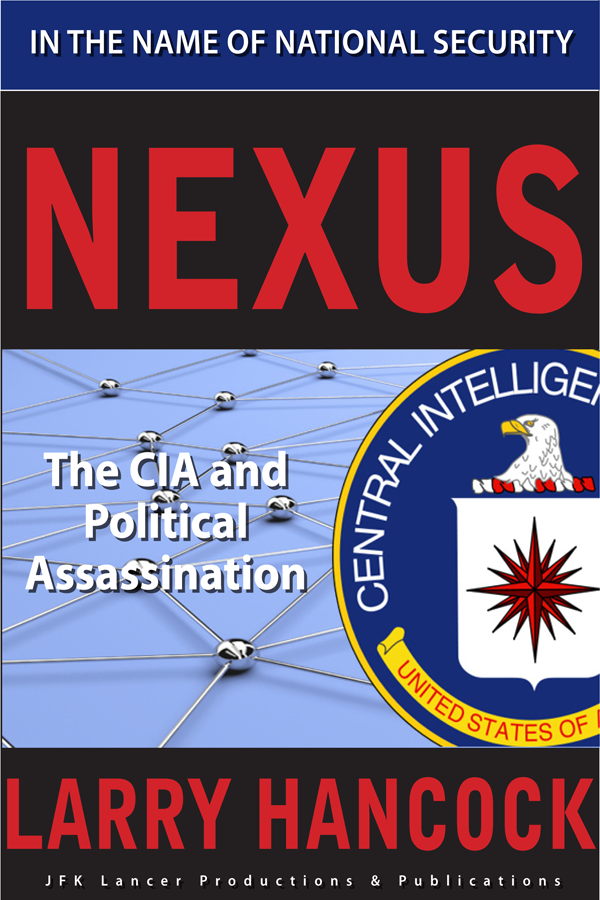
Larry Hancock’s new book Nexus has an interesting and rather unique idea behind it. As Larry explained at the 2011 Lancer Conference in Dallas, the idea here was to trace the Kennedy assassination from a macroscopic view. That is, from the top down rather than from a typical detective story, which works from the bottom up. When I heard Larry talk about this I thought it was a good idea. And something that, to my knowledge, had not been done before. So I looked forward to reading the book.
For a bit over three–fourths of the book, Hancock keeps to that plan. And I found that part of the book interesting and rewarding. The author begins with some good work on the origins of the Cold War and the CIA. I had not known the Joint Chiefs of Staff had a plan for a nuclear attack on Russia in late 1945. Which is really remarkable, since Russia was our ally in World War II. (Hancock, p. 13) He then goes into the famous directive NSC 68, which essentially said that the USA was at war with communism. And that this new kind of war justified Machiavellian ends in order to win out. Therefore, once the CIA was born out of the National Security Act of 1947, many of its covert aspects were done outside the law. And into these covert acts, was built the culture of deniability: That is, a “cover story” was always created in order to be able to shift the blame for the act onto someone else.
Some of these operations were dealt with through so called “soft files”, that is files that were not entered into the CIA’s central filing system. This allowed certain officers to start their own projects that were hard to detect or attribute. (ibid, p. 16)
In 1954, Larry Houston, the CIA’s General Counsel, made out an agreement with Bill Rogers at Justice so that crimes of the CIA would not be prosecuted. (ibid, p. 17) With this agreement, Hancock rightly states that national security was now placed ahead of criminal violations by CIA personnel. This included all crimes up to and including murder.
This agreement was very useful in that it was made the same year of the CIA coup against Jacobo Arbenz in Guatemala. Here, Hancock brings in the most recent declassified study on that operation. He uses it to show that this was perhaps the first time that the CIA actually arranged a so-called “kill list” of certain citizens to be taken care of after the coup. (ibid, p. 19) He also brings in the fact that neighboring leaders Anastasio Somoza of Nicaragua, and Rafael Trujillo of Dominican Republic both agreed to the coup. And, in fact, the bloodthirsty Trujillo requested four specific people be killed. Certain CIA officers wanted Arbenz killed, and his death, of course, to be blamed on the communists. (ibid, p. 20)
What makes this latter fact important is that two famous CIA officers were involved in this overthrow who later figured in the JFK case. They were David Phillips and Howard Hunt. This idea, of killing a liberal head of state and then blaming it on the communists, projects a familiar theme ten years hence. The actual project officer on the coup was Tracy Barnes. From him, the chain of command went to J. C. King, Frank Wisner, Dick Bissell and Allen Dulles.
Hancock has studied the documents of this coup—codenamed PBSUCCESS—carefully. Especially those dealing with the murder lists. In his measured opinion, “Clearly, regardless of any official position being taken in Washington, PBSUCCESS CIA field staff were very much involved with the subject of assassination and actively involved in preparing surrogate personnel to carry out political eliminations.” (ibid, p. 25) In other words, the actual killings were not to be done by CIA agents, but cut outs. Therefore, the hallowed concept of deniability would be followed. In fact, the CIA had an assassination manual prepared in advance for the coup. (ibid, p. 28) And there was actually a discussion at a PBSUCCESS staff meeting in March of 1954 that 15-20 Guatemalan leaders would be killed by gunmen sent over by Trujillo. (ibid, p. 26)
Interestingly, Hancock lists some of the Congressional backers of the coup. They were Lyndon Johnson, Jack Brooks, Martin Dies, and George Smathers. (ibid, p. 31) The message that came down was literally, “Arbenz must go, how does not matter.” (ibid, p. 32) After Guatemala, Barnes and Bissell do further work in assassinations. But also, a lesson is learned: Don’ t put it down in writing. (ibid, pgs. 34-35)
II
Around the time of the Arbenz overthrow, the CIA also learned how to kill people through poisons. And, looking forward, this will be one of the ways that the CIA will brainstorm to kill Patrice Lumumba of the Congo. Hancock deduces from circumstantial evidence that Barnes was involved in the killing of Trujillo in 1961. And around this time, the operations to kill Castro also were in full swing. On these, Bissell had worked with Dulles, while Barnes had run his own attempts. (ibid, p. 40) Although, as Hancock correctly points out, the idea for the plots was also hinted at by Richard Nixon at a National Security Council meeting. (See Oswald and the CIA by John Newman, p. 120) And right after that 1959 NSC meeting, the first phase of the CIA-Mafia plots to kill Castro began.
The idea of “kill lists” was then carried over into the Bay of Pigs planning with the infamous Operation Forty plot. This was designed to get rid of any left-leaning part of the invasion force if the landing was successful.
What the author has so far tried to do is to introduce several gestalt concepts that he will rely upon later:
- The idea that covert operations had a deniability apparatus worked into them.
- That covert actions as sanctioned by the CIA were done in a holy war against communism.
- That since they were so sanctioned they were actually practiced as if they were above the law.
- That these actions even included murder, as was exhibited by the “kill lists” for the Guatemala overthrow.
- After Guatemala, the orders to murder were not placed in writing.
- Later assassination targets were Lumumba, Trujillo, and Castro. The wholesale nature of Operation Forty was a descendant of the “kill lists” for Guatemala.
Now, as John Newman notes in his book Oswald and the CIA, most insiders expected Nixon to become president in 1961. And he was important to the anti-Castro operations already being planned. But Kennedy pulled off an upset. And therefore, this did much to upset the CIA plans against Cuba.
Hancock now introduces the figure of CIA officer William Harvey, who he clearly suspects as being a significant figure in the JFK case. Harvey was involved in two Top Secret CIA operations: Staff D and ZR Rifle. The former was an attempt to use the NSA to figure out opposing nations secret transmittal codes. But it also served as a cover for the latter operation, which was aimed at assassinating foreign leaders. Hancock notes that CIA Director of Plans Richard Helms personally placed Harvey in that position. (Hancock, p. 47)
All of these various elements—deniability, assassination targets, covert acts done outside the law, a holy war against communism—were now to be mixed into a swirling cauldron with many of these same players: Harvey, Bissell, Barnes, Phillips, Dulles and Hunt. The cauldron was called the Bay of Pigs operations, codenamed Operation Zapata. But, as noted, there was one notable alteration to the cast. It was not going to be run by Richard Nixon, who originated much of the official antipathy toward Castro’s revolutionary regime. The responsible officer was going to be John Kennedy.
That was going to make a big difference.
III
From here, Hancock now describes what some previous writers have called, “The Perfect Failure”, and others have termed, “A Brilliant Disaster”. I am referring, of course, to the Bay of Pigs operation. His synopsis and analysis takes up his entire Chapter Seven. It is one of the better short summaries/critiques of this debacle that I have read.
The author begins with an observation first originated by Fletcher Prouty. Namely that between the Eisenhower and Kennedy administrations, the operation seemed to morph from what was essentially intended as a guerilla/infiltration project, until by November of 1960, it became a full fledged amphibious assault. (Ibid, p. 51) Why this was done has never been fully explained. But the author states that the CIA’s Director of Plans, Dick Bissell, is the man who gave the order to alter the operation to the military planner Marine Corps Col. Jack Hawkins. (ibid, p. 53) Once this was done, Hawkins—who was an expert in amphibious assaults—told Bissell that if this was the route he wanted to go then it was necessary to have strong air support. If that was not approved in advance, then the project in that form should be abandoned. The author then notes that this memo, by the project’s main military planner, never got to Kennedy’s desk. It got as high up the chain as Bissell. (ibid, p. 54)
Hawkins was also against the use of tanks and planes. He thought this would all but eliminate the CIA’s plausible deniability. Therefore their use would expose the project as sponsored by the USA.
Hancock next reveals another interesting nugget. The project’s other main designer, CIA officer Jake Esterline, was banned from all the high level meetings. These included those with President Kennedy and other White House advisors and Cabinet members. (ibid) But meanwhile, Bissell was telling Kennedy that the operation would be rather low-key and use minimal air power. This was true for the first plan, under Eisenhower. Which was drafted by Esterline in January of 1960 and approved by Eisenhower in March of that year. But it was not true of this new plan that Bissell had evolved. The first plan used a pool of about 500 Cuban exiles to land at the beach at Trinidad. This group would then unite with the paramilitary groups that the CIA had already developed in opposition to Castro on the island. They would then try and build a larger resistance force with CIA furnished communications equipment. Hancock suggests that one reason this plan was altered was because of the effective crackdown that Castro and Che Guevara had made on resistance groups on the island by late 1960. (ibid, p. 53)
It is important to note here that the two men closest to the operation on the ground, Hawkins and Esterline, are cut off from the White House. Sensing their isolation, as the actual invasion day approached, both Esterline and Hawkins told Bissell that they would resign if the air attacks were not guaranteed. They told him the beachhead could not be established or maintained without it. (ibid, p. 55) Therefore the Cuban T-33 jet fighters had to be eliminated in advance. Yet, as Hancock notes, Bissell acquiesced to Kennedy’s wishes to cut back the number of air attacks by the exiles. And further, during the actual invasion, the CIA turned down an offer to plead their case for more air cover to Kennedy directly. (ibid p. 55)
The author adduces Bissell’s strange behavior to the CIA’s secret attempt to kill Castro during the operation. (ibid) This is an aspect of the project which was kept from Kennedy. I don’t fully agree with this. I believe that both CIA Director Allen Dulles and Bissell both thought that Kennedy would change his mind about direct American involvement in the operation once he was confronted with the stark alternative of defeat. There is no doubt that Nixon would have committed American power: he told Kennedy that is what he would have done. (Arthur Schlesinger, A Thousand Days, p. 288) And Dulles later admitted that this was something he had actually relied upon with Kennedy, that the president would not accept an American humiliation. (Jim Douglass, JFK and the Unspeakable, p. 14)
Because the two internal reports on the Bay of Pigs—Lyman Kirkpatrick’s for the CIA, and Maxwell Taylor’s for the White House—were so closely held, the CIA managed to create a mythology about what really happened. Their cover story was that the plan would have succeeded had the D-Day air raids not been cancelled. When in fact, those raids were reliant on the establishment of a beachhead. (Peter Kornbluh, Bay of Pigs Declassified, pgs. 127-28) Which was not achieved. But as Kirkpatrick pointed out, relying on the D-Day air raid was not realistic. Since the bridges had not been blown, the speed at which Castro got his infantry and armor to the beach made it impossible for 1,500 men to establish a beachhead, let alone to break out from it. (ibid, p. 41) Especially since Castro’s total troop allotment at this time was over 200, 000 men.
But with the CIA’s allies in the media, the failure for the operation was switched to President Kennedy. As far as Hancock’s narrative goes, the reason this reversal is important is that now the CIA had forged a permanent alliance with the Cuban exiles involved with the Bay of Pigs. That bonding was strongly based on their mutual antipathy for the president. In Hancock’s outline of the actual assassination maneuvering, some of these very same Cubans would be used in what they perceived as a retaliation against the man they thought had betrayed them at the Bay of Pigs. And this suspicion and distrust was also felt by Kennedy in reverse. He began to feel as if he could not work with the leaders of the CIA. He therefore fired the top level of the Agency—Dulles, Bissell and Deputy Director Charles Cabell-and placed his own man in charge, John McCone. McCone was not part of the so-called Old Boys network. But he also then supplemented McCone with Robert Kennedy, who served as a sort of ombudsman over Cuban operations. As the author notes, RFK’s presence, and his insistence at reviewing each aspect of each proposed raid on Cuba, greatly agitated William Harvey. (Hancock, p. 80)
IV
After the Bay of Pigs, CIA Counter-Intelligence Chief James Angleton got involved in assessing Castro’s intelligence apparatus. And as Bissell was forcibly retired, Harvey now began to assume more control over Cuban operations. His program was called Task Force W. (Hancock, pgs. 61-62,67) Helms had already placed Harvey in charge of ZR Rifle, but now Angleton comes on board there also. (ibid, p. 65) Harvey now reactivated the Castro assassination plots. He reached out to mobster John Roselli and Cuban exile leader Tony Varona.
During the Missile Crisis, when Harvey made an authorized order to infiltrate CIA contract agents into Cuba, Bobby Kennedy found out about it. Perceiving Harvey as an unreliable cowboy, he had him removed from Cuban operations and eventually relocated to Rome. Des Fitzgerald now took command of the Cuba desk at Langley. (ibid, p. 71)
During this post Bay of Pigs phase, Hancock notes the relationship between Cuban exile leader Antonio Veciana and CIA officer David Phillips. These two first got to know each other on the island and then continued their partnership in the USA. After the Bay of Pigs, which Phillips was a major part of, Phillips began to see that Operation MONGOOSE was not going to be effective at removing Castro. MONGOOSE was the CIA operation that sponsored raids and coordinated attacks by the exiles against Cuba in 1962. But with Robert Kennedy managing it from above, both Harvey and Phillips decided it had no real teeth. It therefore was not going to work. Consequently, Phillips decided he had to do something provocative. Kennedy would only do something strong if his back was to the wall. Phillips had to create headaches for him in order to get him to act. If he had to , he would publicly embarrass him. Therefore, the CIA now began to sanction raids against the island in defiance of directives by the Kennedys. (Hancock, pgs. 83-84)
Hancock then furthers his argument for the motivation of the CIA/Cuban exile alliance against Kennedy. He now notes that the Pentagon had planned on invading Cuba during the Missile Crisis. There had been contingency plans for this operation. They were activated for the Missile Crisis. Fortunately, Kennedy defused the crisis. Fortunate since what no one on the American side knew is that the Russians had installed tactical atomic weapons on the beaches, and Soviet subs stationed there had been outfitted with atomic torpedoes.
But word got out that Kennedy had made a “no invasion” pledge to the Russians over Cuba as part of the resolution to the crisis. That pledge seemed to seal any further hope of the exiles taking back the island. This further exacerbated the hatred felt by the Cubans against Kennedy. They now called him a “traitor”. (Hancock, p. 86)
What made this even worse for the exiles was this: MONGOOSE was retired after the Missile Crisis. What took its place was a very weak program which, as many have written, was just meant to keep the noise level up about Cuba. Hancock notes that, under Des Fitzgerald, very little was done in the first half of 1963. We know from declassified documents that there were only five raids authorized in the second half of that year. Fitzgerald sanctioned an operation to try and create rebellion leading to a coup. Ted Shackley and Dave Morales of the CIA’s JM/Wave station in Miami disapproved. They thought this was completely unrealistic in the face of the controls Castro’s security forces had established on the island. And, in fact, almost everyone contacted to lead the resistance turned out to be a double agent. (Hancock, pgs. 85 and 98)
Operation TILT exemplified the desperation felt by the Cuban exiles and their allies. This was a renegade project. The Special Group inside the White House, headed by RFK, did not authorize it. (ibid, p. 85) This was a June 1963 infiltration operation that was meant to bring back two Russian officers from Cuba. Once returned, they would testify how all the nuclear missiles on the island were not gone yet. In advance of the project, individuals like John Martino—a close ally of the exile community who had served time in Castro’s jails-and exile groups like Alpha 66 shopped the story in advance. In fact, a reporter from Life magazine was a part of the boat mission to Cuba. And even though the Special Group did not authorize the project, Shackley provided logistical support for it. The mission was a complete failure. And it is doubtful that the two Russian officers ever existed.
But what further exasperated the exiles and their allies in the CIA was that Kennedy now moved to honor his “no invasion” pledge. He did this by moving what was left of the anti-Castro operations out of the 48 states. Kennedy enlisted the FBI to enforce this ban. Therefore boats and weapons in the USA were seized. The INS began to issue warnings and to take legal action against the exiles. Pilots had authorizations taken away. (Hancock, p. 95) The war against Cuba now seemed to be over. Some of the remaining exile groups were actually at odds with each other. Manuel Artime hated Manuelo Ray. Shackley liked Artime. He did not like Ray. But Shackley understood why JFK did, since Ray was a liberal. (Hancock, p. 99) Dave Morales, Shackley’s Chief of Staff, felt that Ray had an infiltration program going against the JM/Wave station. So he authorized Artime to fire on Ray’s boats. Things were now going so poorly, they were turning inward.
V
Then came the icing on the cake: the back channel. This refers to Kennedy’s negotiations with Castro through reporter Lisa Howard, diplomat William Attwood, and French journalist Jean Daniel. The goal was to normalize relations with Cuba. This began in January 1963 and continued all the way up to Kennedy’s death. National Security Advisor McGeorge Bundy and Helms were opposed to it. Defense Secretary Robert McNamara looked at it as a way of weaning Castro from the Soviets. In fact, McNamara said the end result could be an ending of the American trade embargo in return for Castro removing all Soviet personnel from the island. (Hancock, pgs. 99-100) Averill Harriman from the State Department was also for it. But he said, “Unfortunately, the CIA is still in charge of Cuba.” (ibid, p. 102) Hancock interestingly notes that Bundy was part of the movement to block any continuance of the back channel when LBJ became president.
Since Helms knew about the back channel, and since the NSA likely was picking up some of Howard’s phone calls, Hancock here makes an interesting assumption. Since Angleton and Helms were good friends, and since Angleton’s domain was counter-intelligence, Angleton very likely knew about the back channel. Through both Helms and the NSA. Since he and Harvey were close in 1963, Angleton had to have told him.
Hancock then advances some interesting evidence that at least three of the Cuban exiles knew about the back channel. They were Rolando Otero, Felipe Vidal Santiago, and Bernardo DeTorres. (Ibid, pgs. 114-15, 122)
Hancock then begins to lay out the plotting around Oswald in the summer of 1963. He clearly implies that this was done to kill off the back channel, which it did. As the time comes to move the plot to Mexico City and Dallas, the occurrences of Oswald “doubles” begin to manifest itself. The author notes the famous Sylvia Odio incident and states that the Odio family was associated with Ray’s group called JURE. And, in fact, Sylvia had just visited with Ray and his assistant that summer. So this may have been an attempt to associate Oswald with the CIA’s least favorite exile group.
From here on in, which is about the last thirty pages or so of the book, I thought Hancock lost sight of his goal. He now begins to lose the macro view of the assassination, that is, from the top down; and he begins a micro view. That is how the ground level worked in Dallas with Ruby as a featured player. Not to say that this information is not interesting. Much of it is. I was especially taken by the work of Anna Marie Kuhns-Walko on Roy Hargraves. The substance of this is that Hargraves had Secret Service credentials and was in Dallas in November of 1963. Hancock does not really recover the macro focus until the very end where he mentions that Harvey’s files were gone through after his death. (Hancock, p. 186) And he finalizes the work with a nice closing quote from Phillips saying that JFK was likely killed in a conspiracy, likely utilizing American intelligence officers. (ibid)
I have some other disagreements. Hancock apparently buys the part of the CIA Inspector General report saying that Roselli met with Jim Garrison in Las Vegas in 1967. In a private letter I saw, Garrison says it never happened. And he would not know Roselli if he saw him.
I disagree with part of Hancock’s analysis on Mexico City. He seems to think Oswald was actually there and did most all the things attributed to him. My view is that Oswald may have been in Mexico City, but the weight of the evidence says he did not do most of the things attributed to him. I also thought the author did not make enough of what was going on with Oswald in New Orleans. After all, the CIA program to counter the Fair Play for Cuba Committee was being run by Phillips. And that is what it appears Oswald was up to in New Orleans. At one point in the narrative Hancock says there is no evidence that Ruby knew JFK was going to be killed in the motorcade route. Well then, what about Julia Ann Mercer? And I would be remiss if I did not say that the book is studded with numerous typos and pagination errors. Apparently, there was a rush to get the volume out for the 48th anniversary.
But overall, I think this is an interesting and worthwhile work. As I said, it has a unique approach to it, and Hancock’s analysis of the crime has sophistication, intelligence and nuance to it. Which, in these days of Lamar Waldron, Tom Hartmann and Mark North, is not all that common.


